FOLLOW ME ON TWITTER AND YOUTUBE

@JaneAustenCode
https://www.youtube.com/watch?v=vKYzhndOGsI https://www.youtube.com/watch?v=G9WkpqjJPR4
(& scroll down to read my literary sleuthing posts)
Thanks! -- Arnie Perlstein, Portland, OR

Thursday, October 16, 2014

Galigai de Concini, Harriot Freke, and Elinor Joddrel: A Chain of Covert Lesbian Allusion Culminating in JA’s Mary Crawford (& in JA’s Letter 159 to Anne Sharp)


Four months ago, I wrote a series of blog posts about Jane Austen’s cryptic reference in Letter 159 (written to Anne Sharp in the last year of JA’s life) to the ill-fated Galigai de Concini, the particular friend of Maria de Medicis:

“But how you are worried! Wherever Distress falls, you are expected to supply Comfort. Lady P. writing to you even from Paris for advice! It is the Influence of Strength over Weakness indeed. Galigai de Concini for ever & ever.-Adeiu.”

That series of posts culminated in one….
…in which I made a prima facie case for Jane Austen having intended, by that reference, to communicate a strong but coded lesbian subtext, which she meant to be decoded and understood only by its addressee, Anne Sharp. I have long believed Anne Sharp to be one of the two women (along with Martha Lloyd) with whom JA had some sort of intense (but, in Anne’s case, obviously almost entirely long-distance) lesbian relationship.

Today, while researching an entirely different, but still very cool, veiled allusion to Edgeworth’s Belinda which I just spotted in one of JA’s novels, I also chanced upon evidence that strengthens my above claim for lesbian subtext in JA’s Letter 159—that evidence is the following passage in Chapter 17 of Belinda, entitled “Rights of Woman”:

"And will you make me lose my bet?" cried Mrs. Freke "Oh, at all events, you must come to the ball!—I'm down for it. But I'll not press it now, because you're frightened out of your poor little wits, I see, at the bare thoughts of doing any thing considered out of rule by these good people. Well, well! it shall be managed for you—leave that to me: I'm used to managing for cowards. Pray tell me—you and Lady Delacour are off, I understand?—Give ye joy!—She and I were once great friends; that is to say, I HAD OVER HER ‘THAT POWER WHICH STRONG MINDS HAVE OVER WEAK ONES,”' but she was too weak for me—one of those people that have neither courage to be good, nor to be bad."
"The courage to be bad," said Belinda, "I believe, indeed, she does not possess."
Mrs. Freke stared. "Why, I heard you had quarrelled with her!"
"If I had," said Belinda, "I hope that I should still do justice to her merits. It is said that people are apt to suffer more by their friends than their enemies. I hope that will never be the case with Lady Delacour, as I confess that I have been one of her friends."
"'Gad, I like your spirit—you don't want courage, I see, to fight even for your enemies. You are just the kind of girl I admire. I see you have been prejudiced against me by Lady Delacour; but whatever stories she may have trumped up, the truth of the matter is this, there's no living with her, she's so jealous—so ridiculously jealous—of that lord of hers, for whom all the time she has the impudence to pretend not to care more than I do for the sole of my boot," said Mrs. Freke, striking it, with her whip; "but she hasn't the courage to give him tit for tat: now this is what I call weakness…”  END QUOTE

Of course, Mrs. Freke (pronounced, not coincidentally, like Henry Crawford’s famous “freaks”) is Harriot Freke, who is, many of you know, one of the two characters mentioned first when the topic of closeted lesbians in the literature of Jane Austen’s era is raised---Elinor Joddrel from Fanny Burney’s The Wanderer being the other.

And so of course a woman like Harriot Freke [who is, famously and obviously---from the title of Chapter 17, for starters---a parody of Mary Wollstonecraft---who had died an awful death only 3 years before Belinda was published] would have known about, and then plausibly invoked in an ironic, but favorable light, Galigai de Concini, who, as my above linked blog post indicated, was rumored to have had a lesbian influence over her powerful patroness, Maria de Medicis, hence the smear about being a “witch”.

And, stepping back for a wider literary perspective, as my Subject Line hints, now I also see Jane Austen (via the character of Mary Crawford, whose lesbian interest in Fanny Price was depicted in Rozema’s Mansfield Park, and has subsequently been unpacked in scholarly fashion by myself and also by my friend Aintzane Legaretta) and Fanny Burney (via the character of Elinor Joddrel in The Wanderer, published 2 months before Mansfield Park) BOTH responding, in different, complicated ways, to Edgeworth. In particular, Mary can be seen as a subtle, wittily understated version of Edgeworth’s wittily over the top original, Harriot.

And finally, as I also stated as I began this post, this also makes it that much more likely that I was right on the money in seeing a lesbian subtext in JA’s allusion to Galigai de Concini in Letter 159 to Anne Sharp. It really is a great chain of covert literary allusion, and it really gives serious pause to wonder about some covert coordination between Jane Austen and Fanny Burney in 1813 when both were composing their respective novels—The Wanderer was discussed by several speakers at the latest JASNA AGM, and I recall enjoying hearing Elaine Bander speak brilliantly about parallels way back at the 2005 (and see the Persuasions article on that topic that Elaine wrote back then).

Jane Austen’s infinitely subtle allusions for ever & ever!

Cheers, ARNIE
@JaneAustenCode on Twitter

P.S.: And Sarah Churchill and Emma’s Harriet Smith are in this same Austenian lesbian mix as well!

Monday, October 13, 2014

MARY Bennet & MARY Crawford as MARY Wollstonecraft, the Satan who whispered to Jane Austen: Jane, the Raffish Disciple of Wollstonecraft, abhorred Polwhele’s misogynistic Unsex’d Females


I just attended the JASNA AGM held in Montreal over this past weekend, which celebrated the bicentennial of Mansfield Park. I had a great time, as I have had nearly every time. I’ve missed only one out of the ten AGMs held since I joined JASNA and began attending them in 2005.

If you are a true Janeite, there is nothing in the world to replicate this experience of being in the presence of about 700 people, most of who are also true Janeites, talking in equal parts about all things Jane but also making friends with people who are mostly (as you might expect) some good combination of smart,  good sense of humor, and attentive to emotional nuance.  

I was one of the unusually large number of Breakout Session presenters this year (and major kudos to Elaine Bander and her AGM crew in beautiful Montreal for opening things up and allowing so many more first or second time presenters to have their/our brief moment in the sun). I was not disappointed in any of the talks I saw, and the Plenary addresses were all excellent as well—in fact, I’d have to rate it my favorite AGM so far, by a small edge over the 2008 AGM about Emma held at the other end of  Canada, in even more beautiful Vancouver.

This was the blurb for my presentation that I gave on Saturday:   

“How many times have we mourned over the dead body of Julius Caesar, and to be’d and not to be’d”:
Scholars have long recognized Mansfield Park’s debts to Shakespeare’s Lear, Henry VIII, All’s Well, As You Like It, and Measure for Measure. However, Austen’s pervasive, faux-throwaway textual hints (e.g., this presentation’s title) also subtly and complexly allude to a tragic quartet: Titus, Troilus, Julius Caesar, and Hamlet….and also to a fifth Shakespeare play I reveal at the end of my talk. These freshly-sleuthed allusions illuminate dark corners of Austen’s famously opaque, ambiguous characterizations, shedding new light on the perplexing moral quandaries this multifariously Shakespearean novel generates.”

I will at some point in the next month begin to post about some of the specific material I covered in my Breakout Session, but in the interim, I do want to mention a particularly striking pulling-together that occurred for me as a happy byproduct of my feverish preparations for my talk during the preceding week.

Specifically, from my intense focus on the Shakespeare that permeates Mansfield Park , I first became aware of how intricately and profoundly connected that Shakespearean subtext is to the Miltonian subtext (specifically Paradise Lost) that also permeates every corner of Mansfield Park. Which of course is not surprising, when you realize that Milton must have been just as brilliant a Shakespeare scholar as Jane Austen was—which is to say, top of the line, far superior to Samuel Johnson, who missed the boat in a major way about a great deal of what Shakespeare was up to.

But then a major light bulb went on in my head when I came across a striking fact that I previously never knew, i.e., that Paradise Lost was a major but mostly covert allusive source for Mary Wollstonecraft’s Vindication of the Rights of Woman! She actually repeatedly uses imagery from Milton’s great epic in a satirical way, turning it on its apparent head.

 I realized, and then quickly verified to my own satisfaction, that Jane Austen had indeed demonstrated repeatedly in her novels, that she picked up, in a very approving way, on Wollstonecraft’s Satanic subtext, by veiled allusions which included, without limitation:

LUCy FERrars being the LUCIFER who covertly manipulates the other characters of S&S so as to bring about the romantic pairings we see at the end of the novel.

Charlotte LUCas being the LUCIFER who pulls off  exactly the same covert tour de force  in P&P, despite the covert opposition of Mary Bennet, whom I identified back in 2010 as the Satanic whisperer who unsuccessfully tries to warn Elizabeth of the danger of marrying Mr. Darcy.

Mary Crawford who is the Satanic siren who unsuccessfully seeks to deter Fanny from marrying Edmund, with Mary’s Zen Buddhist/Mary Magdalenish aphorisms which, as with Mary Bennet’s quotations, all reveal a hidden iceberg of significant allusion when properly understood.

and

Last but not least, the Satanic subtext I don’t recall ever noticing before in the “courtship” charade of Emma! Jocelyn Harris had written in 2009 about the Wollstonecraft subtext of Emma, but in my opinion, Jocelyn did not grasp the correct significance of that subtext. In particular, she did not realize that Wollstonecraft’s protofeminist “heresies” were symbolically represented in the “ courtship” charade!

I.e., she did not realize that Jane Austen chose to code the secret answer “Prince of WHALES” to that charade in no small part because Charles Lamb’s poem “The Triumph of the Whale”, and Cruikshank’s caricature connected to same which I use as the image at the top of my blog, are (as Susan Allen Ford detected back in 2005, when Colleen Sheehan first submitted her article on this secret answer to Persuasions Online), BOTH having as a key allusive subtext the crash-landed whale that is Satan in Paradise Lost!

I see Miss Bates as the secret Satan of Emma, who has fallen far from her early high status, but still quietly but defiantly rebels against the oppression imposed on the women of Highbury by Mr. Knightley and his minions, and successfully saves niece Jane Fairfax from marriage against her will, and finds a safe home for Jane’s illegitimate child with Mrs. Weston.  

And final wonderful touch, which I alluded to in my Subject Line---I also realized that Jane Austen’s covert depiction of Mary Wollstonecraft as a good Satan is actually a rebuttal—indeed a demolition--- of the abhorrently misogynistic satirical poem, Unsex’d Females by Polwhele. It came out in 1798 after Mary Wollstonecraft died in agony after a botched childbirth, and savagely attacked her reputation. Polwhele felt astonishingly strong personal venom toward Wollstonecraft, as we can see in his Preface:

“Miss Wollstonecraft does not blush to say, in an introduction to a book designed for the use of young ladies, that, "in order to lay the axe at the root of corruption, it would be proper to familiarize the sexes to an unreserved discussion of these topics, which are generally avoided in conversation from a principle of false delicacy; and that it would be right to speak of the organs of generation as freely as we mention our eyes or our hands." To such language our botanizing girls are doubtless familiarized: and, they are in a fair way of becoming WORTHY DISCIPLES OF MISS W. If they do not take heed to their ways, they will soon exchange the blush of modesty for the bronze of impudence.”

What a vicious creep Mr. Polwhele must have been! And do you also hear the echo of our discussions only 2 months ago, when we were trying to interpret Jane Austen’s cryptic reference (in an 1801 letter) to a Bath acquaintance Mr. Pickford as being as “raffish” as a “disciple of Godwin”.  

Given that JA wrote that letter only a couple of years after Polwhele’s notorious poem was published, now I see that JA was also thinking of Polwhele’s derisive use of that term to describe followers of Wollstonecraft’s ideas, as well as of Mary Hays’s proudly calling herself a “disciple of Godwin”.

Of course Godwin and Wollstonecraft, the deliberately unmarried parents of Mary Shelley, the future author of Frankenstein , were inextricably linked in the public consciousness.  And this all only reaffirms my belief that for Jane, to be a “raffish” “disciple of Wollstonecraft” was a badge of highest honor, a badge that Jane Austen proudly hid in plain sight in her novels.  

Cheers, ARNIE
@JaneAustenCode on Twitter

Saturday, October 4, 2014

Jane Austen, as an AUTHOR, “played a great deal better” than other writers, “was giving pleasure only to herself”, & “had been always used to feel alone in the world”


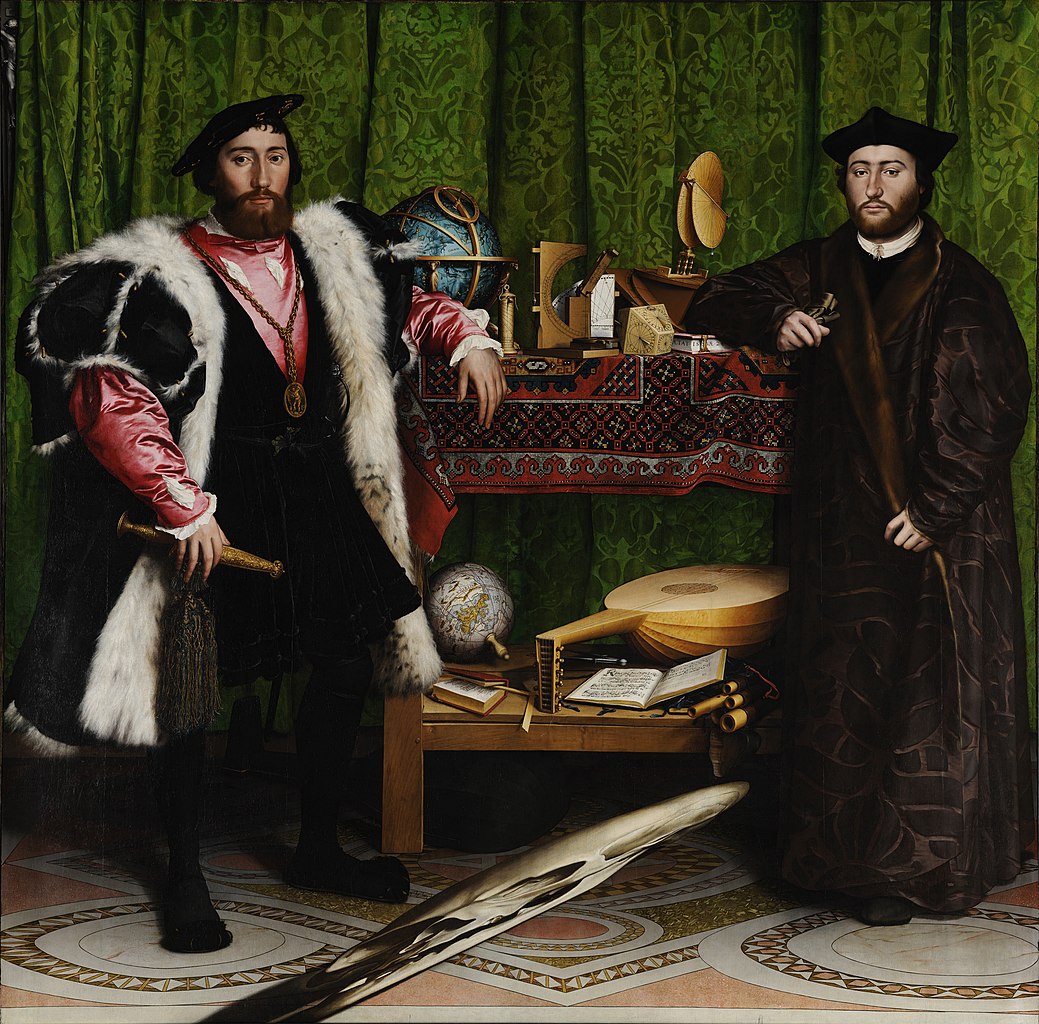
At the core of my countless claims about Jane Austen’s shadow stories is my assertion that they are hidden in plain sight, readily visible only when the reader assumes the proper off-center point of view. The great example of this in the visual arts is Holbein’s famous painting The Ambassadors, in which you can only see the incoherent thin diagonal blob at the bottom center of the painting…


 …as a skull only when you observe the painting from a specific angle from the far left:


Perhaps the most common rebuttal given to me by other Janeites is that if the “skull” in JA’s novels were never observed by other Janeites during the nearly two centuries before I started writing about them, i.e., if it occurred only to such a tiny percentage of Janeites to view the novels from that off-center perspective, then why in the world did Jane Austen go to so much trouble to create elaborate coherent shadow stories in all her novels? What was her purpose if not to have the “skull” be seen, enjoyed, and understood by readers?

I have always believed that JA initially grossly overestimated her readers’s ingenuity—if we look at the order of publication of her novels during her lifetime, you can see a definite progression from 1811 to 1816, at the end of which Emma is hinting much more overtly at secrets and mysteries than Sense & Sensibility did. Even though my research shows that S&S is filled with secrets and mysteries in the same way as Emma, it is no accident that it is the latter which famously has been called a detective story without a murder, not the former.

I am convinced that JA was experimenting, novel by novel, and was observing the reactions of readers very carefully each time, to learn what they saw and what they didn’t see. And when they kept not seeing the shadows with each successive publication, she increased the “illumination” the next time, striving to reach the optimal balance of concealment and clueing.

If you read the opinions of MP and Emma that JA collected from family and friends, there is, with the exception of the brilliant observations by Mrs. Pole and Lady Gordon, precious little else there evidencing any sort of deeper grasp of JA’s great genius. Those opinions are, sadly, almost a Regency Era version of man-on-the-street interviews on the Letterman Show, when, to the great amusement of the viewing audience, those interviewed reveal shallow ignorance coupled with blithe assurance of  knowing what they’re talking about.

It was clearly crucial to JA not to be too obvious---she valued deniability above all, because of the real risk of retribution by the powerful men who were the primary butts of her covert savage satires. She wanted to be deeply understood only by the special victims of her world, the women who might benefit from that understanding by better protecting themselves in their dangerous daily lives.

 And that is why Emma, the last novel published in JA’s lifetime and therefore the last we can be sure that JA herself considered it completely finished, is the only Austen novel with a giant "Gotcha!” ---the revelation that there has been a covert romantic relationship between Jane and Frank from the beginning of the novel onward, which Emma (and therefore the ordinary reader in the first reading) has failed to understand.

The most significant implication of such a “Gotcha!”, if you think about it, is that JA as a writer proved she could pull off such an elaborate stunt of hiding in plain sight over the course of a long intricate novel. But literary history shows that it still took almost two centuries for someone (me) to see that there is another “Gotcha!” hidden right behind the one that is (or seems to be) revealed in Chapter 49.

Which brings me to the primary point of this post. After publication of Emma, we have a period of several months in the first half of 1816, during which JA is finishing Persuasion while at the same time monitoring reactions to Emma, in particular the famous anonymous review (later revealed to have been written by Walter Scott) primarily of Emma.  So by the time JA was finalizing the following passage in Persuasion, she had already learned that her shadow stories, her great secret hidden in plain sight, alas still remained hidden to all her readers.

And so it is at that precise moment near the very end of her writing career, that JA wrote the following passage about Anne Elliot’s piano playing:

“She played a great deal better than either of the Miss Musgroves, but having no voice, no knowledge of the harp, and no fond parents, to sit by and fancy themselves delighted, her performance was little thought of, only out of civility, or to refresh the others, as she was well aware. She knew that when she played she was giving pleasure only to herself; but this was no new sensation. Excepting one short period of her life, she had never, since the age of fourteen, never since the loss of her dear mother, known the happiness of being listened to, or encouraged by any just appreciation or real taste. In music she had been always used to feel alone in the world; and Mr and Mrs Musgrove's fond partiality for their own daughters' performance, and total indifference to any other person's, gave her much more pleasure for their sakes, than mortification for her own.”

Of course we all know that Anne Elliot’s love of, and skill at, the pianoforte was an extremely autobiographical authorial performance on JA’s part----JA played a very similar role in the Austen family circle. She played all her life, and she was a great student of music, both the great and the popular. I’ve also always thought that JA shared Mary Bennet’s study of thorough-bass.

But I think JA in the above passage was also speaking, from the heart but, as usual, in code, about her own writing—if we read “music” as “novel writing”, and we see the Miss Musgroves as the other novelists of her era, then we see JA very matter of factly asserting her own vast superiority over all her writing contemporaries. We see a mature genius who has finally come to terms with not often knowing the happiness of having her greatest achievements as a writer be really understood, other than, perhaps, by a very tiny select few, such as the charming Mr. Haden and the erudite Mrs. Pole.

But the above passage also accords strongly with my sense that JA was not just rationalizing away a bitter disappointment about not being understood. A great deal of JA’s motivation really must have been internal—even if there had been no one else in the world to read her novels, I believe she would still have wanted to write them, because she was in no small part writing them for the sheer exhilaration of the artistic achievement, and then taking great pleasure in the results, which must have astonished even herself with her success.
 
So it fits really well that JA, as a writer, “had always been used to feel alone in the world” and no longer, as a mature writer, felt mortification for her own sake when pompous fools like James Stanier Clarke gave her writing advice! She learned to channel her own Mr. Bennet, and make the best of a bad situation by at least deriving acute pleasure from provoking such absurd self-satirizing responses from such readers.

And speaking of towering geniuses creating for their own pleasure and satisfaction, I am also reminded of the mystery of the origin of Mozart’s final three symphonies---unlike many of his other masterpieces, these were not written on commission for a fee, and I can recall reading critical commentary a while back in which it was speculated that Mozart wrote them just for himself. And they are all three of course in the pantheon of the greatest music ever written.

And then finally as I considered the poignancy of Anne Elliot’s mourning her mother’s death, which was also the end of “the happiness of being listened to, or encouraged by any just appreciation or real taste”, I was reminded again of Mozart and the praise his father received from Haydn in 1785, not long before Mozart’s own premature death, after Haydn had just listened to a performance of three of the six string quartets which Mozart had dedicated to the much older master:

“Before God and as an honest man I tell you that your son is the greatest composer known to me either in person or by name; he has taste, and, furthermore, the most profound knowledge of composition.”

I am guessing from that passage in Persuasion that JA, alas, never heard or read anything approaching such meaningful praise from a fellow author whose opinion she really valued, and so she had to content herself with Scott’s somewhat mixed praise, but mostly with her own pleasure, like Anne Elliot.

Cheers, ARNIE
@JaneAustenCode on Twitter

Wednesday, October 1, 2014

That sweetness so essential to a wife’s worth that sometimes is absent: Mary & Henry’s two tete-a-tetes in Mansfield Park


If I had to choose a single aspect of Jane Austen’s literary technique as the most foundational, yet also the most non-obvious, one, it would have to be her choosing to tell the story of her novels almost exclusively from the point of view of the heroine. The rationale for my choice—when a story is told almost exclusively from one character’s point of view, and yet is narrated in third, not first, person, it allows an ingenious, sly author like Jane Austen to create fundamental ambiguity in an infinite number of ways, i.e., she can put the aware reader to the test of determining, on every page of all six novels, whether the narration should be understood to be objective or subjective. And that ambiguity also accounts, in part, for the extraordinary REreadability of JA’s novels.

But the most significant benefit of JA’s extraordinary use of point of view is that it allowed her to inobtrusively create her double story structure---i.e., consistent “objective narration” interpretation yields the overt story that every Janeite knows, whereas consistent “subjective narration” interpretation involves the reader looking behind the heroine’s subjective (and therefore potentially unreliable) point of view, and to find the shadow story lurking at the corners of the heroine’s field of vision.

As an important corollary of the above, in these six novels where nearly all of the scenes described include the presence of the heroine, the very rare scenes from which the heroine is absent must be of extraordinary interest. I’ve previously written about the tiny handful of tete-a-tetes which do not include the heroine, scenes which occur early in a JA novel….
…in which characters whom I call “policy-makers” (Fanny & John Dashwood, Sir Thomas & Mrs. Norris, Knightley & Mrs. Weston, and Sir Walter & Mr. Shepherd) discuss matters which affect the future of the heroine. These scenes open doors into the motivations and concerns of those other major characters, and yet, anyone who has closely read those scenes knows that for every bit of insight they provide into those other characters’s minds, they raise five questions about them—JA teases us with those scenes, repeatedly making us wonder what those characters mean by what they say to each other when the heroine is not around.

Perhaps the most blatant example of that sort of teasing occurs in the following exchange between Knightley and Mrs. Weston:

"I dare say," replied Mrs. Weston, smiling, "that I thought so then;—but since we have parted, I can never remember Emma's omitting to do any thing I wished."
"There is hardly any desiring to refresh such a memory as that,"—said Mr. Knightley, feelingly; and for a moment or two he had done….”

Obviously, these two characters know exactly which memory it is of Emma “omitting to do any thing Mrs. Weston wished” prior to the wedding that Knightley gets so emotional about---they each know what her smiling “then” and his feeling “that” refer to; but, unless I am asleep at the switch, I believe there is no clear clue as to what they mean. So, following Chekhov’s famous aesthetic dictum about the rifle that must eventually be fired, JA must have wanted her readers at some point to start searching through the rest of the novel for clues which may let us in on the secret of what Knightley remembered.

Which brings me to the main subject of this post. I don’t recall ever previously noticing the parallelism between those early-in-the-novel tete-a-tetes, on the one hand, and the extended tete-a-tete between Mary and Henry, about Fanny, in Chapter 30 of MP, in which Henry surprises Mary with his announcement that he plans to marry Fanny, on the other. And, to make it a bit more complex, Chapter 30 is not a stand-alone affair, it is clearly a bookend to a shorter tete-a-tete between those same Crawford siblings, also talking about Henry and Fanny,  which occurs about a month earlier in the novel’s chronology, in Chapter 24. In that earlier conversation, Henry announces to Mary his intent to play the heartless rake and make a hole in Fanny’s heart. That sets the stage for Mary’s great surprise when Henry announces to her, such a short time later, that he has changed course 90 degrees, and now plans to play the unfamiliar role of Faithful Mate rather than his habitual role of Seducing Rake.

With that prelude, I heartily recommend to you all the exercise of rereading just those two tete-a-tetes between Mary and Henry---nearly every line of narration and dialog in them has subtle meanings to be parsed, and it is the most extended window we get in MP into the depths and mysteries of these two enigmatic protean characters. We are reading what they say, and some of what they are thinking and feeling, unfiltered or clouded by whatever judgments and reactions Fanny might have had, had she been a fly on the wall overhearing them.

And yet, as I just illustrated with the above-quoted Knightley example, more questions are raised in these two scenes than are answered. For example, when we read Mary, who has just made an incorrect guess as to Henry’s purpose in his secret mission to London, saying….

"Well, well, I am satisfied. I know now to whom it must relate, and am in no hurry for the rest. Fanny Price! wonderful, quite wonderful! That Mansfield should have done so much for—that you should have found your fate in Mansfield!...”

…I believe we are meant by JA to wonder how Mary was going to finish “That Mansfield should have done so much for—“. 

Was she going to say “Fanny”, as a reflection on the sharp irony of Fanny’s being brought to Mansfield at age 8 having finally brought a great benefit to Fanny, after a decade of being ignored, intimidated, and/or abused by most everyone in the Bertram clan? That would fit with Mary’s consistent empathy for Fanny throughout the novel.

Or, was Mary going to say “you”, referring to Henry getting a great benefit from coming to Mansfield Park, but then she quickly rephrases because she’s afraid Henry will take that the wrong way and so Mary tactfully tries to avoid ruffling his pride, by using the vague word “fate”?

Or, was Mary going to say ”us”?---i.e., was this a hint that JA tantalizes us with, as to a possible motivation for the Crawfords coming to Mansfield Park in the first place? I.e., does this tell us that they showed up out of  the thin blue air at Mansfield Park, rather like Satan cruising in from Pandaemonium and pulling into the Garden of Eden, with nefarious intent? Did they show up wanting, perhaps out of a desire for revenge for wrongs in the past, to have something done for them? Or are they like Frederick in Lover’s Vows, who returns to the place of his birth to see his mother, and winds up discovering that he is the  illegitimate son of the local squire, Baron Wildenhaim, who finally marries Frederick’s mother Agatha?

All of those possibilities exist by virtue of that dash---but then, this is not surprising, because I learned to read behind JA’s dashes from Emma--- indeed one could write “a long note” (as Emma might have said, about Miss Bates’s many incomplete sentences ending in dashes) speculating about how Miss Bates was going to end each of those sentences.

For today, I have one very specific textual question as to MP Chapter 30--I wonder if nay of you will have any better luck than I in interpreting the meaning of the end of the following passage, when Mary and Fanny discuss Fanny:

“Fanny's beauty of face and figure, Fanny's graces of manner and goodness of heart, were the exhaustless theme. The gentleness, modesty, and sweetness of her character were warmly expatiated on; that sweetness which makes so essential a part of every woman's worth in the judgment of man, that though he sometimes loves where it is not, he can never believe it absent.”

Does that last part mean that every marrying man believes that his wife is sweet, even though men sometimes love and marry women who are actually not sweet at all? And am I correct that “sweetness” is a euphemism for “compliant”? Or something else? And, perhaps interesting question, who is the one of the two Crawfords who voices this somewhat cynical view? I am pretty sure it’s Mary, it has that same ring of her numerous acute psychological observations, and it seems spoken from a woman’s point of view, with a very refined sense of irony. I.e., is it Mary throwing a subtle barb at Henry’s attachment, tenuous as it may be, to Maria Bertram Rushworth, who is not at all sweet?

Lots of mystery in that passage which I had previously blown by the first 20 times I read Chapter 30, but now I find myself utterly engrossed in these miniature mysteries.

I welcome any thoughts on any of the above, particularly that last question.

Cheers, ARNIE
@JaneAustenCode on Twitter