FOLLOW ME ON TWITTER AND YOUTUBE

@JaneAustenCode
https://www.youtube.com/watch?v=vKYzhndOGsI https://www.youtube.com/watch?v=G9WkpqjJPR4
(& scroll down to read my literary sleuthing posts)
Thanks! -- Arnie Perlstein, Portland, OR

Friday, May 13, 2016

Why Sir Walter Scott’s brilliant, subversive 1816 reading of P&P has not prevailed among Janeites

In my previous post, I quoted the following passage from Sir Walter Scott’s 1816 review of Jane Austen’s writing, which included this about P&P:

".....The story of the piece [P&P] consists chiefly in the fates of the second sister, to whom a man of high birth, large fortune, but haughty and reserved manners, becomes attached, in spite of the discredit thrown upon the object of his affection by the vulgarity and ill-conduct of her relations. The lady, on the contrary, hurt at the contempt of her connections, which the lover does not even attempt to suppress, and prejudiced against him on other accounts, refuses the hand which he ungraciously offers, and does not perceive that she has done a foolish thing until she accidentally visits a very handsome seat and grounds belonging to her admirer. They chance to meet exactly as her prudence had begun to subdue her prejudice; and after some essential services rendered to her family, the lover becomes encouraged to renew his addresses, and the novel ends happily..... "

I became curious to see if any later Austen scholars had ever engaged with Scott’s subversive reading, which (again) suggests that Elizabeth’s sudden emergence of loving feelings toward Darcy arose because she had been overawed and seduced by the wealth and grandeur of Pemberley.

And I found a remarkable reaction to Scott, in “Jane Austen ob. July 18, 1817” an article by renowned early 20th century Austen scholar, Reginald Farrer, in The Quarterly Review.I had not previously read Farrer’s July, 1917 commemoration of Austen on the centennial of her death, but now I see that it contains a quintessential example of how the Myth of Jane Austen has blinded even the most insightful Austen scholars to evidence of her shadow stories, even when it has been placed right in front of their noses by the one contemporary of Jane Austen who would have been the best example possible of a sophisticated contemporary reader of her novels--- Sir Walter Scott, in the above quoted passage. Scott, after all, was the author whom JA famously jokingly wished would stop writing such successful novels, because he was making it so hard for other authors like her to get their books published, sold, and read.

For starters, the following passage in Farrar’s article is of interest, because Farrer so blithely states, as facts, assertions about JA’s writing which I believe most Janeites today, including myself, would consider  either wrong or wrong-headed—see if you can spot Farrers’s errors of fact and opinion about P&P:

“But now comes the greatest miracle of English Literature. Straight on the heels of Lady Susan and Sense and Sensibility this country parson’s daughter of barely twenty-one breaks covert with a book of such effortless mastery, such easy and sustained brilliance, as would seem quite beyond reach of any but the most mature genius. Yet, though Pride and Prejudice has probably given more perfect pleasure than any other novel (Elizabeth, to Jane Austen first, and now to all time, ‘is as delightful a creature as ever appeared in print,’ literature’s most radiant heroine, besides being the most personally redolent of her creator), its very youthful note of joyousness is also the negation of that deeper quality which makes the later work so inexhaustible. Without ingratitude to the inimitable sparkle of this glorious book, even Northanger Abbey, in its different scale, must be recognised as of a more sumptuous vintage. Pride and Prejudice is, in fact, alone among the Immortal Five, a story pure and simple, though unfolded in and by character, indeed, with a dexterity which the author never aimed at repeating. For, as Jane Austen’s power and personality unfold, character becomes more and more the very fabric of her works, and the later books are entirely absorbed and dominated by their leading figures; whereas Darcy and Elizabeth are actors among others in their comedy, instead of being the very essence of it, like Anne or Emma. And to the reader, the difference is that, whereas he can never come to an end of the subtle delights that lurk in every sentence of the later books, there does come a point at which he has Pride and Prejudice completely assimilated.
Perhaps Jane Austen never quite recovered this first fine careless rapture; still, the book has other signs of youth. It has a vice-word, ‘tolerably,’ and its dialogue retains traces of Fanny Burney. Compare the heavy latinised paragraphs of the crucial quarrel between Darcy and Elizabeth (the sentence which proved so indelible a whip-lash to Darcy’s pride is hardly capable of delivery in dialogue at all, still less by a young girl in a tottering passion) with the crisp and crashing exchanges in the parallel scene between Elton and Emma. The later book provides another comparison. Throughout, when once its secret is grasped, the reader is left in no doubt that subconsciously Emma was in love with Knightley all the time.”  END QUOTE FROM FARRER

I leave it you to count all the questionable assertions that Farrer makes in the above passage, in particular his claim that the dialog of the first proposal scene between Darcy and Elizabeth is “hardly capable of delivery in dialogue at all” –anyone who has seen Jennifer Ehle and Colin Firth deliver those very same lines would beg to disagree, right?

But now we come to the point, as Mr. Bennet would say. Here is where Farrer blithely slams Sir Walter Scott’s 1816 comments about P&P, which I quoted above:

“In Pride and Prejudice the author has rather fumbled with an analogous psychological situation, and is so far from making clear the real feeling which underlies Elizabeth’s deliberately fostered dislike of Darcy, that she has uncharacteristically left herself open to such a monstrous misreading as Sir Walter Scott’s, who believed that Elizabeth was subdued to Darcy by the sight of Pemberley. In point of fact, we are expressly told that her inevitable feeling, ‘this might have been mine,’ is instantly extinguished by the belief that she could not bear it to be hers, at the price of having Darcy too; while her subsequent remark to Jane is emphatically a joke, and is immediately so treated by Jane herself (‘another entreaty that she would be serious,’ etc.), wiser than some later readers of the scene. Sir Walter’s example should be a warning of how easy it is to trip even amid the looser mesh of Jane Austen’s early work. Rapid reading of her is faulty reading….”

Now do you see a quintessential example of why Jane Austen’s shadow stories have not been spotted and properly understood for 200 years. The legitimate question of whether Sir Walter Scott has makes an incisive subversive interpretation of the climax of P&P is begged in the most cavalier, superficial manner by Farrer, and yet Farrer has the intellectual chutzpah to accuse Scott of reading P&P too fast to have understood it properly! Physician, heal thyself, I say!

Note in particular how Farrer accuses JA of making a rather large mistake, i.e., in leaving Elizabeth’s feelings about Darcy ambiguous. Farrer thereby implicitly and inadvertently concedes that there is an ambiguity in the novel on this crucial point—but again, with colossal chutzpah, he accuses JA herself of having “rather fumbled” the execution of this central aspect of her novel. And on top of that, he inadvertently also reveals that he has so misunderstood the manner in which P&P was composed by JA—did you note that he believed that JA wrote P&P at 21? That shows that Farrer did not bother to read JA’s 1812 letter in which she reported to Cassandra about her progress, at age 37, in lopping and cropping P&P for publication. Again, Mr. Farrer, physician heal thyself!

And finally note how Farrer accuses Scott of the “monstrous misreading” of that “mistake”, when Scott takes JA’s ambiguity as intentional on JA’s part. And then Farrer gives as “proof” that Scott has misread JA  two pieces of evidence which are anything but probative, because they can very plausibly be read as (1) Elizabeth’s self-deluding rationalizations about her immunity from the seduction of wealth and power; and (2) yet another ignoring of unpleasantness by Jane Bennet, the quintessential Pollyanna, who ought to be the last character in the world to cite as an authority on whether Elizabeth was joking!

But, who was ever going to challenge Farrer, in 1917…..or in 2016, for that matter, with these sorts of objections, other than a stubborn obsessive contrarian like myself? Nobody! Only I have had both the necessary firmness of belief that Scott was correct, plus, in the past 15 years (out of the 203 years since P&P was published), the power of the Internet and computers at my disposal, with all that those resources provide. And I’ve also been fortunate to have had the enormous amount of time to completely research the entire range of Austen scholarship—in particular, the ability to gather hundreds of nuggets like Scott’s, and to put them all in their proper place in a well organized argument, alongside my own discoveries.

And that’s yet another reason why Jane Austen’s shadow stories have not been discovered until now.

Cheers, ARNIE

@JaneAustenCode on Twitter

"We all love to instruct": the didactic purpose of Jane Austen's double stories

My friendly skeptic Nancy Mayer was at it again yesterday in Janeites, giving me yet another prompt to explain myself in a different way: 
"Jane Austen didn't have to go to the lengths of a Da Vinci code  rigmarole  to publish her cautionary tales. She could have published them openly and called them cautionary tales for  young women on the verge of marriage. She was a genius . She would have found a way if she'd  wished."
Nancy, I'll explain this one more time,  since you keep ignoring my repeated explanations of this very point. I've often mentioned the strange Zen paradox that JA put in the mouth of Elizabeth Bennet ("We all love to instruct though we can teach only what is not worth knowing") in this regard, and will do so again now.

I claim that Jane Austen wished to instruct her female readers about the perils not only of the Wickhams of her world but also of the bad Darcys (as opposed to the good Darcys), too. 

And JA realized that just straightforwardly instructing her female readers that rich, powerful handsome men who couldn't take no for an answer could be even more seductive than smooth tongued penniless charmers like Wickham, would be "teaching what is not worth knowing", because a cocky country girl like Elizabeth, who considered herself a great amateur psychologist (studies of character) would just laugh that warning off, and say something like "oh, I wouldn't be that naive, I'm not a fortune hunter, i will marry for love, not money".

But how much more effective a lesson can be indirectly taught in two steps. First JA seduces the female reader to fall in love with Darcy at the end of P&P right along with Elizabeth, and get totally swept up in the fantasy of reforming a narcissistic jerk just by telling him off really well one time! That fantasy is SO powerful, that it has made P&P the most popular love novel of our time, and the 1996 P&P the most popular love film for sophisticated viewers.

But Then later upon rereading (just as Elizabeth changes her mind after repeated rereading of  Darcy's letter, not coincidentally), when the reader eventually becomes aware of the shadow story, the reader can feel that frisson of scary self awareness - "uh-oh, OMG,  it seems that I bought into that unrealistic fantasy just as much as Elizabeth did-I'm actually more vulnerable to the seduction of money and power than I realized. I better be extra alert to that risk the next time a man like Darcy appears in my life.".

That is experiential learning rather than passive ingestion of a "lesson" and is therefore much more powerful than the straightforward lecture you say JA could have written, warning about the dangers of such a man. 

Because JA understood what Shakespeare and Milton "taught" her. Satan (or Iago) operates that way, by whispering in our ears, subtly appealing  to our vanity, and hinting that we would be safe to voluntarily walk down a garden path to our own destruction. Influence is most powerful when the victim buys into the seducer's suggestion, and takes it on as her own idea. 

And finally, speaking of readers seeing parts of the elephant but not realizing there were two stories in one novel, guess who recognized, way back in 1816, that the joke was really on Elizabeth in P&P?:

".....The story of the piece [P&P] consists chiefly in the fates of the second sister, to whom a man of high birth, large fortune, but haughty and reserved manners, becomes attached, in spite of the discredit thrown upon the object of his affection by the vulgarity and ill-conduct of her relations. The lady, on the contrary, hurt at the contempt of her connections, which the lover does not even attempt to suppress, and prejudiced against him on other accounts, refuses the hand which he ungraciously offers, and does not perceive that she has done a foolish thing until she accidentally visits a very handsome seat and grounds belonging to her admirer. They chance to meet exactly as her prudence had begun to subdue her prejudice; and after some essential services rendered to her family, the lover becomes encouraged to renew his addresses, and the novel ends happily..... "

Scott brilliantly nudged open the door, but didn't realize that there was a double story structure.

And finally it's no coincidence that Elizabeth utters that Zen parable to Jane in the same conversation in which Elizabeth jokes about dating her own falling in love with Darcy from the moment she first saw Pemberley. But as I've said many times, in the shadow story the joke was on Elizabeth.

So, at least now I hope you will know and keep in mind what I'm actually saying, and if you want to still disagree, then so be it.

Cheers,
Arnie
@JaneAustenCode on Twitter 

Thursday, May 12, 2016

Jane Austen’s “obscured” figure-ground novels


In the Janeites group, a skeptic named Louise responded to one of my recent posts, and I respond as follows: 

Louise wrote: "I don't see what the point was of her writing 'shadow stories' so obscure that nobody found out about them until 200 years later."

Louise I'm satisfied with my explanation, which, briefly again is that they weren't discovered till now primarily because of the active and successful obfuscation of the Austen family from 1817 onward. People see what they expect to see, and explain away the rest as “imaginary” or “mistake”. That’s exactly what has happened in this instance.

As anyone who’s closely followed my posts the past decade would know, I've collected a huge number of readerly reactions to JA’s novels, dating back to JA's lifetime, when readers (other than me) have (to my mind correctly) spotted pieces of the proverbial elephant (i.e., JA’s shadow stories). However, in pretty much every instance until the present day, having been told by everyone else that there was no “elephant” there, they explained away what they saw as either the product of their own overactive imagination, or as JA having been careless about inadvertently creating the appearance of an alternative version of a given character; or similar rationalizations.

So, in short, I say you’re begging the most important question when you refer to JA’s shadow stories as “obscure” – I believe “obscured” is a better descriptor, because what should have been visible on rereading of the novels has been obscured by a deeply erroneous orthodoxy in interpreting JA’s novels. Just because “it is a truth universally acknowledged” that JA’s novels do not have shadow stories, that doesn’t mean it’s true, only that most people believe it to be true.


Louise also wrote: "As for warning readers against the dangers of predatory men - she does that quite openly in her books, there are many charming men who turn out to be bad lots."

As I’ve also explained many times, yes indeed those seducers were identified in JA's overt stories. But it was the powerful Machiavellian hypocrites, who pretended to be reliable and honest, who could be even more dangerous - like the shadow Darcy or shadow Knightley I've written about so often. It wasn’t an “either/or” situation with male predators in JA’s era, alas, it was a “both” scenario. In short, Wickham being bad did not mean Darcy had to be good, he could also be bad, but in a different way.


Louise also wrote: "The main problem with there being 'shadow stories' though is that Jane Austen's characters have always seemed like real people to me, it's what is so clever about her writing.  If they are really just cardboard cutouts who can be viewed one way or another, that ruins the whole thing.  I don't believe she intended that at all.  I think her characters were real to her, just as they are to her readers."


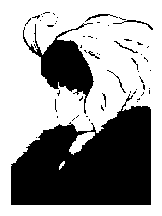
Louise, to reply to arguments like yours, I've often used the example of the familiar figure-ground image, like this one… http://www.afn.org/~gestalt/haggirl.gif  


  …to make my point about the ambiguity and anamorphism of Jane Austen’s shadow stories. If you’re willing to spend 15 minutes on a little experiment, perhaps you’ll be surprised at what happens, and I’d love to hear what happens if you (or anyone else reading this) takes a shot at it.

So now, look at that linked image. What do you see? (scroll down after you give it a go for a few minutes)


[scroll down]


[scroll down]


[scroll down]


Speaking for myself, when I first looked at it this morning (I had last looked at it a few years ago), what I saw initially was only the image of a fashionable young woman with a lot of dark hair wearing a large round hat of some kind.  She is looking back and to the viewer’s left, but you can’t see her eyes at all. I am guessing that this is what most people see, but perhaps that’s not so. What did you see?

Now, had I not already known that there was a second possible female face visible in that same image, I seriously doubt I’d ever have seen the second one – not because it is not there, but because I wouldn’t even have looked for it!

It’s only because I knew in advance that this is a figure-ground image, that I kept looking, and kept struggling to free myself from the tyranny of that initial “overt” image. It was only then that, after a few minutes, something flipped in my brain, and I suddenly “saw” the old woman; she is also looking to the left, but the young woman’s delicate jawline has now miraculously morphed into a very large Roman nose in the old woman. The old woman’s left eye seems to just be peeping out from under her hair, and she’s wearing a kind of scarf wrapped closely on her head.  Do you see her?

Now, how does this work this way? The human brain is mysterious, but it’s clear that we are each capable of organizing ambiguous images from the visual world into different “gestalts”. That’s the whole point of the Rorschach test, which is to create an image that is so ambiguous that it can readily be seen as 100 different objects.

But with a different sort of image, one deliberately designed to be ambiguous between two “gestalts”, like the one I linked to, we are capable of flipping back and forth between them in our minds. Go ahead and try it, and you’ll see that you can see the young woman, then see the old woman, then go back again, ad infinitum. The more repetitions, the easier it becomes.

And that brings me to my main point, which rebuts your above comment. Is the image of the young woman any less real or complex, now that we know that there is also the face of an old woman there as well? Has it become more of a “cardboard figure”, to use your terminology? Of course not! They both seem real and complex, just different.

The various visual elements are ambiguous, and have been carefully chosen so as to create two distinct visual pathways for interpretation by the brain. Even though I didn’t see the old woman until I worked hard at it, now I see both with equal ease. My brain has obviously learned to see the old woman too, in part by remembering to notice her large nose, her headscarf, her tiny eye.

And all I am saying to you is that Jane Austen, using words on pages, achieved that exact same result with the characters and storylines of the six novels--- for example, Harriet Smith may be the naïve impulsive doofus that Emma sees her as throughout most of the novel, or she may be the hard nosed, pragmatic, ambitious young woman who suddenly shows her face to Emma late in the novel, and shocks Emma with the news that Harriet has her sights set on Knightley. Which one is real?  Both of them! It does not diminish the complexity of Harriet the trusting doofus, if there is also a Harriet the manipulative fortune hunter. Actually, they constitute a fascinating contrast with each other. But, they can’t be combined – Harriet cannot be a schemer in one scene, and a doofus in the next one, because human personality (at least in people who do not suffer from psychosis) is very stable.

And finally, this also explains why I so readily see elements of JA’s shadow stories, whereas I had to really struggle to see them 14 years ago, when I saw my first one (Willoughby was stalking Marianne when she falls and twists her ankle). As I’ve often recounted, it took me 2 ½ years to reach the epiphany that all of JA’s novels have coherent shadow stories. Up till then, I kept gathering more and more shadow story elements, but I kept trying to squeeze these literary square blocks into the circular holes of the novels as customarily read. It was only when I realized Jane Fairfax’s concealed pregnancy, and Frank’s having murdered his aunt, in early 2005, that the scales fell from my eyes. 

And since then, by means of frequent continuous practice, a few thousand times over the past 14 years, I’ve trained my brain to recognize the particular sort of anamorphism that JA created in her fiction, utilizing ambiguous wordplay and situations rather than the lines and shadings of the figure-ground image of the old/young women. It’s truly a breathtaking beautiful artistry that she must have developed, like Mozart writing his late masterpieces. And that is already reason enough to want to become acquainted with her shadow stories. They are like discovering another six Austen novels!

And this is one important reason why my theory sounds so crazy to you – the shadow story does not pop out in your mind as a whole, the way the old woman does in the visual image. Obviously, a Jane Austen novel has complexity on a scale thousands of times larger than a simple visual image. So it is a leap of faith to take the intellectual/cognitive journey required in order to really see the shadow stories as “real”—and also to learn to move back and forth between it and the overt story, as I have now also learned to do.

You may well ask at this point—this sounds like a gigantic amount of work—why should I bother, beyond appreciating JA’s artistry? And my answer is, another hidden benefit of such an exercise is that this sort of skill is widely generalizable to all sort of creative thinking. I have often pointed out that my longtime crossword puzzle addiction is one of the key factors that predisposed me to see Jane Austen’s shadow stories. They both depend on developing brain flexibility and pattern recognition skill. And guess what? I have found (and my wife, who is a clinical psychologist who has been a skilled therapist for a quarter century, agrees) that this skill can be transferred into real life, allowing a person to read their own and other people’s characters with greater nuance, allowing for the possibility of moving beyond “first impressions” to more nuanced interpretations of the personalities of ourselves and those around us. That was JA’s didactic purpose, I believe, but alas, her ambitions were thwarted by her premature death and the snow job her family then perpetrated on the reading public at large. But now the light bulb can be switched on again.

[For those who want to read two earlier explanations of mine emphasizing different aspects of Jane Austen's double stories, here are links to two other posts at this same blog:
Thank you for your interest!]

Cheers, ARNIE 
@JaneAustenCode on Twitter

Wednesday, May 11, 2016

My latest defense of my theory of Jane Austen’s shadow stories

In the Janeites listserv, Nancy Mayer (whom I think of as my personal “Friendly Skeptic” because she is never convinced by my arguments, and yet she is unfailingly polite in her skepticism) restated yet again her old objections to my theory of Jane Austen’s shadow stories, giving me the opportunity to restate my answers according to my most current understanding, which has evolved over the past decade:

Nancy: "I do get tired of all the changing partners and imaginary lovers and sexual predators that people are driven to create. Please, as I have suggested before, do write those novels-- just don't defame Jane
with having created them."

Nancy, we've been down this road before --- every time you make a comment like that, I explain to you that I see one underlying and highly laudatory goal for Jane Austen having written novels which include
shadow stories in which many of the main characters other than the heroine are "flipped" from "good guys" to "bad guys", or from fools to geniuses:

First and foremost, I see JA's shadow stories as sophisticated cautionary tales, which exactly counterbalance the sophisticated romance of the overt stories. In a nutshell, and using P&P as one example among six:

If Darcy really is a good guy who reforms and repents his former arrogant selfish ways, then you have the story that has warmed many millions of hearts over 2 centuries. But if Darcy really is a bad guy who only pretends to reform and repent, because he's just one of those narcissistic men who cannot take no for
an answer, then you have the sophisticated cautionary tale of the shadow story. Neither is intended by JA to be understood as having an exclusive claim to be "reality"--both are possibliities, both of them fit the narrative on the page.

I believe her goal was to educate women (not in a conduct book lecture fashion, but by using the powerful experience of reading fiction as a tool to enable her female readers to read their own lives better, and be
prepared for the next man who walks in her door to be EITHER a good guy OR a bad guy.

And for the cautionary tale to have power and be effective, it had to present all the horrible things that really did happen in her world, most of which involved men oppressing women, and much of it having to do with women's bodies (serial pregnancy, sexual predation, freedom and ease of travel, etc). That was reality --men routinely did abuse the power that religion, custom, and law gave them.

So why is it defaming Jane Austen to say that she was a whistleblower, shining a light on the domestic Gothic of everyday English family life?


Nancy then responded to my above answer with this followup: "How can it be a cautionary tale if no one ever knew it? Jane Austen was too smart and too talented to be so obscure. She could have written that story more boldly."

Good question, and also one I've answered before, but I will be happy to answer it again, with three reasons which interacted with each other in complicated ways:

ONE: You overestimate her freedom to write the shadow story more boldly. She had reason to feel extremely vulnerable on a personal level, if she openly wrote what she actually thought. Remember, she had no savings, and was utterly dependent on family for room and shelter, not to say travel and leisure activities. She was not a martyr, and wasn't willing to go down in flames in order to make a point.

TWO: As an author, her primary goal with her shadow stories, I believe, was to reach women, and she feared (rightly I believe) that she would never even get published if she were too clear that she was advocating for radical readjustment of gender relations in British society.

THREE: And here's the complicated ironic aesthetic/didactic reason--it was necessary to structure the novels so that the socially acceptable overt story would be accessible by reading with the grain, where the
subversive shadow story would be accessible only by reading against the grain. The most effective way to give a reader an "Aha!" moment about being overly passive in accepting society's narratives about one's own life, would be to first seduce female readers into the very satisfying sophisticated, nuanced romance of the stories, and then, when they reread in order to enjoy the pleasure of the romance again,  their
subconscious minds would have had the chance to begin to notice subliminal hints pointing to the shadow story.

What was impossible for her to do, however, was to accurately judge, ahead of time, how close to come to crossing the line of deniability ("Do not be suspecting me of a pun") in each successive novel, without crossing it. Each publication was therefore a kind of experiment, that's why she collected reader responses as she did for MP and Emma. She was trying to gauge what was or was not being detected by her readers.

Now that I have had so much time to decode all of her fiction, beginning with the earliest Juvenilia and running right up to the deathbed poem, I can see a clear progression over time:

The Juvenilia is wildly transgressive, but was never intended to be published; same with Lady Susan.

As she went from one published novel to the next, she kept finding that nobody was "getting" the shadow stories, and so each time she upped the ante. That's why Emma, which was the fourth novel to be published in her lifetime, has its famous "Gotcha!" with the revelation of the secret 9/10 through the novel, that compels a rereading to understand what has really happened. The meta-message of that "Gotcha!", to a reader who was paying attention, is that JA was capable of pulling the wool over
readers's eyes, so maybe readers ought to be more suspicious about ALL her fiction, to see if there were other such secrets.  Plus I see her getting closer and closer to making the same-sex love themes of her
shadow stories more and more visible.

So, for all these interacting reasons, Austen proceeded cautiously. I truly believe that had she even lived to the age of 50, and had written 3-4 more novels, and had become as famous as, say, Maria Edgeworth or
Fanny Burney, and felt independent and secure enough, she would have gone public in some way with what she had been up to.

But we all know what happened instead--she died rather abruptly at 41 1/2, and then her family went into overdrive to create the Myth of Jane Austen. Whatever chance there was that readers would begin to see the shadow stories was squashed--because the key to seeing the shadow stories is the willingness to believe they MIGHT be there.  If you've been told that she did not transgress as a writer (just read Henry's Bio Notice, and JEAL's Memoir protesting way too much about what she DIDN'T do in her writing!), you will have to be a very very stubborn reader to think otherwise.

As Jane Austen the amateur epistemologist recognized, people pretty much see only what they expect to see --- the naive observer just assumes the objectivity of the world he or she sees, whereas the wiser observer recognizes his or her own hard wired subjectivity, and struggles to come up with ways of partially freeing themselves from the tyranny of one's own pride and prejudice.

This is why all six novels are so strictly written from a single point of view, that of the heroine, with less than 1% of every novel giving VERY brief windows into the minds of certain other characters --in
effect, we as readers are imprisoned in the minds of JA's young heroines, who all believe they know what is going on around them, but, in the shadow story, are utterly clueless.

Cheers, ARNIE
@JaneAustenCode on Twitter

Tuesday, May 10, 2016

Lady Susan, Jane Austen, & Diana Parker for ever & ever: the strong, immortal female mind

In Janeites, Ellen Moody wrote this about Jane Austen's novella, Lady Susan: 
“My suggestion was it’s a radical inverted protest novel. Austen is getting away with protesting her own and other women’s situations through presenting a heroine all will detest. There were ways for women to express themselves “contra mundi”: I saw her as turning to a sub-genre or kind of book that allowed this. Epistolary narrative, and French amoral anti-heroines. She can express herself through such a heroine as a mask. This was an era when spinsters were harshly criticized and mocked in conduct books, sent up cruelly in novels. She was despised for not having sex, but as a woman with little money and no power she’d be worse ostracized and punished for admitting knowing about sex, much less trying to live a pleasurable life of sex on her own without a man controlling her. This is the type of woman we find in these novels, only they are often widows or domineer over husbands and lovers, or simply living independently (if they had wealth somehow).”

I agree with a lot of what you say, above, Ellen, but couch my position differently, and go further in some ways.

First, I see a very striking resemblance between Lady Susan and another Austen character who has not been mentioned yet in this discussion, but who should be --- Lucy Steele in S&S --- whose married name, as I first pointed out a decade ago, is LUCY FERRARS aka "Lucifer! Lady Susan, like Lucy, is a woman without scruples who gets her way by using her own superior psychological acumen to exert influence over others - and she particularly rises to the challenge when someone dares to stand in her path and attempt to thwart her.  She feels free to in effect “invade” a wealthy family, and wreak havoc in it, the way a skilled borderline personality can do (and some of you may be aware of Christine Shih’s claims that borderline personality was a key theme in Austen’s writing).

And I see Lucy doing exactly the same once she "invades" the Ferrars family -- in particular, in the way that I see Lucy as holding Edward on a string, and neutralizing sad clueless Elinor by making her her "confidante" , while she does her real work behind the scenes on Robert, setting up the mousetrap on the Ferrars family. And then, when the time is just right, her secret is "accidentally" revealed by her sister, and the trap is sprung on Mrs. Ferrars, who unwittingly does Lucy's bidding by disinheriting Edward, and making Robert her vested heir—whereupon Mrs. Ferrars has no way to squirm out of that trap. 

I think that part of what makes many readers lack sympathy for the victims of Lady Susan's guile is that she is a woman, who manages to turn what is ordinarily a kind of death sentence for women in that era --becoming a widow without money--into opportunity for herself --- sorta like a self-serving Robin Hood.


Second, I think we find a continuation of JA’s grudging admiration for an amoral rake like Lady Susan and her ability to subvert male authority at will, in JA’s famous and very candid comment to Martha Lloyd in her 1812:

"I suppose all the World is sitting in Judgement upon the Princess of Wales's Letter. Poor woman, I shall support her as long as I can, because she is a Woman, & because I hate her Husband -- but I can hardly forgive her for calling herself ``attached & affectionate' to a Man whom she must detest -- & the intimacy said to subsist between her & Lady Oxford is bad -- I do not know what to do about it; but if I must give up the Princess, I am resolved at least always to think that she would have been respectable, if the Prince had behaved only tolerably by her at first. --"

In effect, Lady Susan is Princess Caroline on steroids --- and JA might have said about Lady Susan something like “if I must give up Lady Susan, I am resolved at least always to think that she would have been respectable, if the patriarchal social system had not been totally rigged against women, and she could have attained personal fulfilment in an ethical way".


And finally, in case anyone thinks Jane Austen as she got older was no longer in tune with having a villainess as heroine of an Austen story, just remember what JA wrote in her next to last surviving letter to her old dear friend Anne Sharp, only months before JA's death (I quoted this same passage in my post yesterday about Diana Parker in Sanditon, who bears some resemblance to Lady Susan in her exertion of influence on several people at once, like one of those circus jugglers who  can keep ten dishes twirling at the same time at the top of ten sticks):

"Lady P. writing to you even from Paris for advice!-It is the Influence of Strength over Weakness indeed.-Galigai de Concini for ever & ever.-Adeiu.- “

"the influence of Strength over Weakness indeed"! That could very well be Lady Susan’s motto as well, right?  I am thinking now about what she writes to his bosom buddy Alicia Johnson about Reginald de Courcy that partakes of the same attitude:

“He is lively & seems clever, & when I have inspired him with greater respect for me than his sister's kind offices have implanted, he may be an agreable Flirt. There is exquisite pleasure in subduing an insolent spirit, in making a person predetermined to dislike, acknowledge one's superiority. I have disconcerted him already by my calm reserve; & it shall be my endeavour to humble the Pride of these self-important De Courcies still lower, to convince Mrs . Vernon that her sisterly cautions have been bestowed in vain, & to persuade Reginald that she has scandalously belied me. This project will serve at least to amuse me, &prevent my feeling so acutely this dreadful separation from You & all whom I love. Adeiu.
  Yours Ever S. Vernon.”
  
And Jane Austen herself, from the time she first picked up a quill pen as a teenaged author, to the day she died when she was too sick to even hold a pen, and  despite her being a woman with little money, managed to use the enormous strength of her mind to achieve true immortality, and give inspiration to countless women, over ten generations and counting, who've read her novels, and derived strength and inspiration to be strong despite gender-based obstacles still placed in their path.

To read my post after seeing Whit Stillman's spectacular film adaptation of Lady Susan entitled Love and Friendship in January, here it is: http://tinyurl.com/pb5nbfb  

Cheers, ARNIE

 @JaneAustenCode on Twitter

Jane Austen didn’t stoop to folly, she rose to artistic conquest, in the backstory of Emma

 In the Janeites group, Jane Fox wrote: "I'm guessing JA read Oliver Goldsmith. I'm also guessing that he meant this, and that this was read, wryly or even as irony. Comments?”

When lovely woman stoops to folly, 
And finds too late that men betray, 
What charm can sooth her melancholy, 
What art can wash her guilt away? 
The only art her guilt to cover, 
To hide her shame from every eye, 
To give repentance to her lover, 
And wring his bosom—is to die.

PART ONE: GOLDSMITH’S “WHEN LOVELY WOMAN STOOPS TO FOLLY” IN EMMA

Jane, it's not a guess, the following narrative comment is right there in the text of Emma, quoting Goldsmith’s famous poem explicitly in relation to Mrs. Churchill's suspiciously sudden death: "Goldsmith tells us, that when lovely woman stoops to folly, she has nothing to do but to die; and when she stoops to be disagreeable, it is equally to be recommended as a clearer of ill-fame."

[I’m just curious--what was it that made you suspect that JA read Goldsmith, if it wasn’t that passage?]

To answer to your question, certainly Goldsmith must have been highly ironic in suggesting that the only option for a woman who’d been betrayed sexually ---i.e., who’d been impregnated outside wedlock--- was to kill herself. What kind of moral monster would Goldsmith have been, had he been serious?

What I think is an even more interesting question is, what did JA mean by this allusion to Goldsmith’s poem? On the surface, her meaning seems straightforward. She ironically adds "disagreeableness" to the list of female follies, the ill-fame of which can only be cleared by death. It’s a biting irony about the cruelly unfair oppression of women in JA’s world, and JA relished such irony in safely venting her righteous feminist anger about this unfairness -- even when the woman who dies is so thoroughly “disagreeable” as Mrs. Churchill! Recall how in 1812, JA was ready to forgive Princess Caroline for her numerous sexual follies, because, JA believed, she had been driven to them by the cruel mistreatment she endured from her husband the Prince Regent.

However, beyond that overt meaning, I now suggest that, within the backstory of Emma, Jane Austen was hinting that the first Mrs. Weston (nee Miss Churchill), Mrs. Churchill’s sister in law, had actually “stooped” to “folly” with a young male betrayer. After all, "ill fame" was a term applied to a woman guilty of sexual indiscretion  And “stoop” is a euphemistic English verb which sounds a lot like—and I suspect is etymologically related to—the very graphic and vulgar Yiddish verb, shtup, meaning to f---k.

I wondered whether “stoop” had once had a similarly vulgar meaning in English, and sure enough, it did! Here is a usage in Thomas Middleton’s 1657 play Women Beware Women:

WARD:
If I but live
To keep a house, I’ll make thee a great man,
If meat and drink can do’t. I CAN STOOP GALLANTLY
And pitch out when I list; I’m dog at a hole.
I mar’l my guardianer does not seek a wife for me;
I protest I’ll have a bout with the maids else,
Or contract myself at midnight to the larder-woman
In presence of a fool or a sack-posset.

In their 1988 edition, Bryan Loughrey & Neil Taylor gloss the above speech as follows:  “the literal sense of this passage is obscure. Probably ‘stoop’, ‘pitch out’ and ‘hole’ were part of the technical vocabulary of Cat and Trap, and the Ward is bragging of his prowess. HOWEVER, EACH OF THESE TERMS ALSO HAS A BAWDY MEANING: ‘STOOP’ = F—K; ‘pitch out’ = ejaculate; and ‘hole’ = c—t … ’have a bout’ = fornicate.” 

So, it seems clear to me now that JA recognized Goldsmith’s sexual double entendre with “stoop”.  But that’s not all—please read this portion of Wikipedia’s synopsis of Middleton’s play, and you tell me which character in Emma you’re strongly reminded of in the character of Bianca:

“Women Beware Women tells the story of Bianca, a woman who escapes from her rich home to elope with the poor Leantio. Fearful and insecure, Leantio requires that his mother lock Bianca up while he is away. While locked up, the Duke of Florence spots Bianca in a window and attempts to woo her with the help of Livia, a widow. When Leantio returns he discovers that Bianca has been corrupted and no longer loves him because he lacks wealth and fortune….as affairs and relationships are exposed, one of the bloodiest Jacobean tragedies is created.”

Doesn’t Miss Churchill fit Bianca to a tee? I.e., like Middleton’s Bianca, Miss Churchill also leaves her rich home to elope with the poor Captain Weston, and then Miss Churchill also no longer is satisfied with Captain Weston, because he lacks wealth and fortune! And finally, she Miss C fills the bill of a woman who “stoops’ to sexual folly in another crucial Goldsmithian aspect—she dies not too long thereafter, fulfilling Goldsmith’s ironic proscription!

So, if JA means us to figure out that Miss Churchill did stoop to such a sexual folly, who was the (then) young man who knocked her up? Given that Frank Weston had to be the product of an illicit liaison in order for folly to have been stooped to, the biological father must be someone other than her husband, Captain Weston. And now I amaze even myself with the seemingly preposterous suggestion that this line of backstory sleuthing dovetails perfectly with another recent post of mine about Emma… http://tinyurl.com/jcvso9z   … in which I speculated that the biological father of Frank (a latter day Oedipus) was none other than Mr. Woodhouse!

In that recent post, I suggested that Miss Taylor was Frank’s biological mother, but now I wish to switch to Miss Churchill instead, because of these veiled allusions to Goldsmith and Middleton.  And if Frank really is Miss Churchill’s biological son, then it still makes sense that Captain Weston would, after a suitable delay of a couple of years, “sell” Frank back to his maternal aunt and uncle—especially as it appears that Mr. Churchill may have been sterile, given that he and Mrs. Churchill were childless.

PART TWO: GOLDSMITH’S THE VICAR OF WAKEFIELD IN EMMA

But that poem is only the beginning of the Goldsmith I see hidden in plain sight in Emma. We also have the equally explicit reference to Goldsmith’s famous novel, The Vicar of Wakefield, which occurs in this exchange between Emma and Harriet:
"Mr. Martin, I suppose, is not a man of information beyond the line of his own business? He does not read?"
"Oh yes!—that is, no—I do not know—but I believe he has read a good deal—but not what you would think any thing of. He reads the Agricultural Reports, and some other books that lay in one of the window seats—but he reads all them to himself. But sometimes of an evening, before we went to cards, he would read something aloud out of the Elegant Extracts, very entertaining. And I KNOW HE HAS READ THE VICAR OF WAKEFIELD. He never read the Romance of the Forest, nor The Children of the Abbey. He had never heard of such books before I mentioned them, but he is determined to get them now as soon as ever he can."

So, why would Harriet recommend Vicar to Robert Martin? Perhaps we may find the answer in the following excerpt from “The Gentleman Farmer in Emma: Agrarian Writing and Jane Austen's Cultural Idealism”  by Robert James Merrett (U. of Toronto Quarterly 77/2, Spr. ’08) . Please in particular see the part of Merrett’s argument that I put in ALL CAPS, and you tell me which character in Emma you are thereby particularly reminded of:

“Two reasons explain why Austen makes Robert Martin's fictional point of reference in Emma Oliver Goldsmith's Vicar of Wakefield. Firstly, she will have known this romance was the most popular of 18th-century novels. Secondly, she will have appreciated that in his depiction of Squire Thornhill, the vicar's landlord, and of Burchell, the disguised Sir William Thornhill, uncle to the squire, Goldsmith adopts a stance that balances Richardson's optimism with Fielding's pessimism about land tenure. THE SQUIRE IS full of 'high life' and 'fashionable cant'. No farmer, but A THOUGHTLESS HUNTSMAN WHO HIRES PROSTITUTES, HE SEDUCES TENANTS’ DAUGHTERS BY AFFECTING BENEVOLENCE while holding aloof from rural life BY PRETENDING TO BE SUBJECT TO HIS ‘ATTORNEY AND STEWARD’. When Dr Primrose rents one of Thornhill's farms – twenty acres of excellent land consisting of 'little enclosures' neatly defined by 'elms and hedge rows' – things seem idyllic. Local farmers, retaining a 'primeval simplicity of manners,' till their land untouched by urban 'superfluity' . Affectation somewhat impedes the Primroses' adaptation to farm life...Blind to Burchell's authenticity, they subject themselves to the squire's power. When the vicar cannot pay his rent, the steward seizes his cattle, selling them for less than half their value. But Burchell comes to their aid; he works on the Primroses' farm, helping to save 'an after-growth of hay' and to turn 'the swath to the wind'…He saves the vicar from debtors' prison and exposes his nephew.” END QUOTE

Of course I’m referring to Mr. Knightley, who: (1) is the squire of Emma ; (2) appears to benevolently govern his neighbors, (3) prefers the company and is guided by the counsel of his steward William Larkins; and (4) is the landlord to Robert Martin, the tenant farmer whom Harriet has urged to read Vicar. Hmmm……that makes 4 out of 5 very direct and specific links between the roguish Squire Thornhill and the upright Mr. Knightley. Does it make you wonder, as it makes me wonder, about the fifth data point---that part about “hiring prostitutes”! Mr. Knightley, a seemingly virile heterosexual man who has never been married --- what do you think about the possibility that he was like Squire Thornhill in seeking out ladies of the evening (or as Miss Bates drily put it re Mrs. Elton, “queen of the evening”)?  

PART THREE: GOLDSMITH’S SHE STOOPS TO CONQUER IN EMMA

The above two explicit allusions to Goldsmith in the same Austen novel (and Emma has more explicit allusions scattered throughout its entire length---as opposed to the bunching of explicit allusions at the beginning of Northanger Abbey--- than any other Austen novel, surely because she was frustrated that her implicit allusions were not being recognized by her readers) are still not all the Goldsmith to be mined from Emma. There’s also a third Goldsmith work, the play She Stoops to Conquer, which lurks behind those other two. Please check out this Wikipedia synopsis (and, again, please focus on the ALL CAPS):

“Wealthy countryman Mr. Hardcastle arranges for his daughter Kate to meet Charles Marlow, the son of a rich Londoner, hoping the pair will marry. Unfortunately, Marlow is nervous around upper-class women, yet the complete opposite around working-class women. On his first acquaintance with Kate, the latter realises she will have to pretend to be 'common', or Marlow will not woo her. Thus Kate 'stoops to conquer', by posing as a maid, hoping to put Marlow at his ease so he falls for her. Marlow sets out for the Hardcastle's manor with a friend, George Hastings, an admirer of Miss Constance Neville, another young lady who lives with the Hardcastles. During the journey the two men become lost and stop at an alehouse, The Three Jolly Pigeons, for directions. Tony Lumpkin, Kate's step-brother and cousin of Constance, comes across the two strangers at the alehouse and, realising their identity, plays a practical joke by telling them that they are a long way from their destination and will have to stay overnight at an inn. The "inn" he directs them to is in fact the home of the Hardcastles. When they arrive, the Hardcastles, who have been expecting them, go out of their way to make them welcome. However, Marlow and Hastings, believing themselves in an inn, behave extremely disdainfully towards their hosts. Hardcastle bears their unwitting insults with forbearance, because of his friendship with Marlow's father. Kate learns of her suitor's shyness from Constance and a servant tells her about Tony's trick. SHE DECIDES TO MASQUERADE AS A SERVING-MAID (CHANGING HER ACCENT AND GARB) TO GET TO KNOW HIM. Marlow falls in love with her and plans to elope with her but, because she appears of a lower class, acts in a somewhat bawdy manner around her. All misunderstandings are resolved by the end, thanks to an appearance by Sir Charles Marlow. The main sub-plot concerns the secret romance between Constance and Hastings. Constance needs her jewels, an inheritance, guarded by Tony's mother, Mrs. Hardcastle, who wants Constance to marry her son, to keep the jewels in the family. Tony despises the thought of marrying Constance — he prefers a barmaid at the alehouse — and so agrees to steal the jewels from his mother's safekeeping for Constance, so she can elope to France with Hastings. The play concludes with Kate's plan succeeding: she and Marlow become engaged. Tony discovers his mother has lied about his being "of age" and thus entitled to his inheritance. HE REFUSES TO MARRY CONSTANCE, WHO IS THEN ELIGIBLE TO RECEIVE HER JEWELS and become engaged to Hastings, which she does.”

As I’ve opined numerous times, I see the Harriet Smith of the shadow story of Emma as an ambitious, clever, manipulator who (much like Lucy Steele in S&S, or Shamela in Fielding’s parody of Pamela) attempts to level the playing field using her guile, in particular her ability to wrap Emma around her little finger by sucking up to the rich but cluelessly naive heiress. In that sense, I see Kate Hardcastle, who adopts a very similar strategy to nab herself a rich husband, as a source for Harriet, who, however, is foiled in her ambition to wed Knightley and is made to settle instead for Robert Martin.

Plus, I see in Constance a source for Jane Fairfax, in particular in regard to the jewels which Jane winds up receiving after Mrs. Churchill’s conveniently sudden death, as Frank whispers to Emma (and JA whispers to the reader):
“You will be glad to hear (inclining his head, and whispering seriously) that my uncle means to give her all my aunt's jewels. They are to be new set. I am resolved to have some in an ornament for the head. Will not it be beautiful in her dark hair?"

And Jane as Constance Neville also fits with the fact that the words “stoop” and “conquer”, which both appear in Emma (stoop actually occurs 7 times in Emma, and only once in all five other Austen novels combined!) actually are most closely associated in Emma with Jane Fairfax:

“…Jane looked as if she did not mean to be CONQUERED; but instead of answering, she began speaking again to Mr. John Knightley...”

“…only objection to gathering strawberries the STOOPING—glaring sun—TIRED TO DEATH—COULD BEAR IT NO LONGER—must go and sit in the shade…."

In Frank’s letter to Mrs. Weston:
“…I dared not address [Jane] openly; my difficulties in the then state of Enscombe must be too well known to require definition; and I was fortunate enough to prevail, before we parted at Weymouth, and to induce the most upright female mind in the creation TO STOOP in charity TO A SECRET ENGAGEMENT.—Had she refused, I should have gone mad….”

PART FOUR: JANE AUSTEN’S REAL LIFE IN EMMA VIA GOLDSMITH

I’ve claimed for over 11 years now that Jane’s concealed pregnancy is the driving force of the shadow story of Emma, and that John Knightley is the baby daddy, not Frank, whom Jane throws herself at in Weymouth in order to snag a husband soon enough to legitimize her unborn child. Therefore it fits perfectly for Jane to be associated with Goldsmith’s fiction and poetry about women who are forced to deal with “ill-fame” as best they can—and Jane finds a way, with a LOT of secret help from her friends, not to die, but to survive (and also for her baby to survive, even if the child is to be raised by Mrs. Weston instead of Jane).

And…coming around full circle back to Goldsmith’s poem which led off this post, let me now suggest Jane Fairfax as a second referent for Jane Austen’s allusion to a young woman who stooped to folly, and (in Jane’s case) might have died as a result, but did not. You may recall the account I’ve often told, that 9 years ago, I told Anielka Briggs my theory of the secretly pregnant Jane Fairfax giving her baby to Mrs. Weston to raise as Anna Weston, whereupon Anielka brilliantly upped the ante, by showing that “Anna Weston” was a coded transformation of “Ann Awe-ston”  = “Anna Austen”, who of course was Jane Austen’s niece. What JA meant by this double code is up for grabs as to whether it was JA’s fantasy about a beloved niece, or a real life account of a beloved illegitimate child.

But what I note now, for the first time, is that the toddler Frank Weston was given over by his birth father Captain Weston to Frank’s maternal aunt Mrs. Churchill at almost the same age that Anna Austen was given over by her birth father James Austen (for the three years it took James to remarry) to the primary care of Anna’s paternal aunts Jane & Cassandra Austen.

This suggests to me that Jane Austen spun herself off into three different female characters in Emma who, all stooped to folly:

Miss Churchill, mother of illegitimate Frank;
Jane Fairfax, mother of illegitimate Anna; and
Miss Bates, mother of illegitimate Harriet.

In creating such a beautiful and complex backstory of illegitimacy in Emma, Jane Austen the author did not stoop to folly, she rose to conquer (artistically speaking).

Cheers, ARNIE

@JaneAustenCode on Twitter

Monday, May 9, 2016

More re Austen’s ironic self-portrait as hypochondriac hypocritical busybody Diana Parker in Sanditon

Two weeks ago, I wrote a post… http://tinyurl.com/hcom2zu  …entitled
“Sanditon‘s “unaccountable” Diana Parker as dying Jane Austen’s veiled lesbian self-portrait”.

In that post, I pointed out the striking (and never previously noticed) parallel between two paragraphs written by Jane Austen in the Spring of 1817, both of which harked back to a famous aphorism about strong and weak minds, attributed to Galigai de Concini (Maria de Medeci’s close female advisor—and more) as she was about to be burnt at the stake in 1617. This same aphorism had previously been requoted in Lord Chesterfield’s Letters to his Son and by Maria Edgeworth in both Leonora and Belinda.

The first passage by JA is in Letter 159, written by her on May 22, 1817 (2 months before her death) to her dear friend (and a woman JA loved much more than as a friend), Ann Sharpe:

“Beleive me, I was interested in all you wrote, though with all the Egotism of an Invalid I write only of myself.-Your Charity to the poor Woman I trust fails no more in effect, than I am sure it does in exertion. What an interest it must be to you all! & how gladly sh. I contribute more than my good wishes, were it possible!-But how you are worried! Wherever Distress falls, you are expected to supply Comfort.  Lady P. writing to you even from Paris for advice!-IT IS THE INFLUENCE OF STRENGTH OVER WEAKNESS INDEED.-Galigai de Concini for ever & ever.-Adeiu.- “

The second passage is in the Sanditon fragment JA stopped writing in April, 1817, in which Diana Parker (the character I claim was a veiled self-portrait by JA) refers to her own and her sister’s strong minds:

“…Miss Heywood, I astonish you. You hardly know what to make of me. I see by your looks that you are not used to such quick measures."
The words "Unaccountable officiousness!—Activity run mad!" had just passed through Charlotte's mind, but a civil answer was easy.
"I dare say I do look surprised," said [Charlotte], "because these are very great exertions, and I know what invalids both you and your sister are.
"Invalids indeed. I trust there are not three people in England who have so sad a right to that appellation! But my dear Miss Heywood, we are sent into this world to be as extensively useful as possible, and where some degree of strength of mind is given, it is not a feeble body which will excuse us or incline us to excuse ourselves. THE WORLD IS PRETTY MUCH DIVIDED BETWEEN THE WEAK OF MIND AND THE STRONG; between those who can act and those who cannot; and it is the bounden duty of the capable to let no opportunity of being useful escape them. My sister's complaints and mine are happily not often of a nature to threaten existence immediately. And as long as we can exert ourselves to be of use to others, I am convinced that the body is the better for the refreshment the mind receives in doing its duty. While I have been travelling with this object in view, I have been perfectly well."
The entrance of the children ended this little panegyric on her own disposition…”

What I didn’t notice two weeks ago, was that this was only half of the echoing between Sanditon and her contemporaneous final letters, on the specific topic of personal strength and weakness. I became aware of the other half today, when I read the following speech by Diana Parker’s younger brother, Mr. Parker, while talking to heroine Charlotte about his sisters (Diana and the elder Miss Parker) prior to the arrival of those two ladies in Sanditon:

“And you must know, [Sidney] will have it there is a good deal of imagination in my two sisters' complaints. But it really is not so, or very little. They have wretched health, as you have heard us say frequently, and are subject to a variety of very serious disorders. Indeed, I do not believe they know what a day's health is. And at the same time, they are such excellent useful women and have so much energy of character that where any good is to be done, they force themselves on exertions which, to those who do not thoroughly know them, have an extraordinary appearance. But there is really no affectation about them, you know. THEY HAVE ONLY WEAKER CONSTITUTIONS AND STRONGER MINDS THAN ARE OFTEN MET WITH, either separate or together…”

I only then realized that Diana’s speech was actually a close echo of her brother’s comments, in referring to her and her sister’s strong minds in the context of referring to their bodily weakness:

“it is not a feeble body which will excuse us or incline us to excuse ourselves…. as long as we can exert ourselves to be of use to others, I am convinced that the body is the better for the refreshment the mind receives in doing its duty. While I have been travelling with this object in view, I have been perfectly well.”

It makes perfect sense that Mr. Parker would mouth his sister’s words, because he has surely heard her speak the same shpiel many times before.

But that’s not all. I went back to Le Faye’s edition of JA’s letters, and found another passage in yet another of JA’s final letters, on the same theme! It’s in the letter written by JA less than a month before  the one she wrote to Anne Sharpe, and it’s to brother Charles, dated April 27, 1817, containing this passage:

“I live upstairs however for the present & am coddled. I am the only one of the Legatees who has been so silly, but A WEAK BODY MUST EXCUSE WEAK NERVES. My Mother has born the forgetfulness of her extremely well—her expectations for herself were never beyond the extreme of moderation, & she thinks with you that my Uncle always looked forward to surviving her…”

So we see even more clearly how much Jane Austen the novelist was pouring into her new fictional creation, Diana Parker, the essence of the tragedy of Jane Austen the human being in her last year of life: the tragedy of a genius-strong mind finding itself trapped inside a prematurely dying body. And of course, being Jane Austen, she did this in a highly ironic fashion—i.e., just as Miss Bates was the healthy JA’s ironic self portrait, in 1815, as a healthy tedious foolish busybody, so too was the “unaccountable” Diana Parker the dying JA’s ironic self portrait in 1817, as a hypochondriac tedious hypocritical busybody.

I see in what JA wrote to her younger brother Charles the need JA felt to minimize her serious illness, in order to spare her family. And who knows whether there were those in the family (such as entitled niece Fanny or spiteful sister in law Mary Lloyd?) who may’ve actually seen Jane as a hypochondriac, with her mysterious illness that came and went—until, of course, it came and stayed.

And all of the above also fits with her final written words, dictated to her sister in the last few days of her life—the poem “When Winchester Races”---which, as I’ve written a number of times, is Jane Austen’s  ironic, defiant thumbing of her nose at Death and at those who thought her fiction would die with her. Even as her weak body was about to finally surrender, her still strong mind screamed its final defiance:

“When once we are buried, you think we are gone. But behold me immortal!”

If only she had been given the time to give us Diana Parker in all her glory, everything I now see in Sanditon tells me JA would’ve given us priceless additional hints at the passionate, protean genius concealed behind that mask of irony.


Cheers, ARNIE
@JaneAustenCode on Twitter